Climate-related metrics and targets
Amongst other things, Swiss Life works with metrics and targets to assess climate-related risks and opportunities and to track progress towards the achievement of corresponding targets. Both help to ensure the future resilience of Swiss Life’s business model.
In order to include different perspectives on climate-related issues and gain experience with metrics and measurement methods, Swiss Life compiles and uses a selection of different metrics and projections. All relevant areas of the company can thus develop their knowledge around climate-related metrics and measurement methods.
Climate-related metrics and the underlying methodologies belong to a relatively young – and hence still evolving – field of research, are often complex and offer only limited comparability as yet. Moreover, climate-related metrics are based on assumptions and are therefore inherently subject to model risk. An additional challenge is that there is currently no broad consensus on the methodology used for climate-related metrics. The quality and availability of the underlying data are limited, which ultimately makes the climate-related metrics less meaningful. In its external reporting, Swiss Life currently focuses on climate-related metrics whose methodology is mature and recognised and which reflect both risks and opportunities for Swiss Life and their impact on relevant stakeholder groups. Metrics communicated externally by Swiss Life also contribute to greater transparency.
In the area of investments, Swiss Life regularly procures climate-related metrics and projections –climate-related metrics such as from the independent providers MSCI, Bloomberg, Germanwatch and the Energy and Climate Intelligence Unit (ECIU), and projections in particular from the NGFS. This involves using backward-looking metrics such as greenhouse gas emissions on the one hand and forward-looking metrics and projections from scenario analyses on the other hand.
In order to better assess its understanding of climate-related risks, Swiss Life has been participating in initiatives such as the PACTA-based Swiss Climate Test since 2017. This test is carried out by the Swiss Federal Office for the Environment (FOEN) and by the State Secretariat for International Finance (SIF).
For the reporting of greenhouse gas emissions, the internationally recognised standards of the Greenhouse Gas Protocol (GHG Protocol) are applied. These comprise the GHG Protocol Corporate Standard, the GHG Protocol Scope 2 Guidance and the GHG Protocol Corporate Value Chain Standard. The Financed Emissions Standard issued by the Partnership for Carbon Accounting Financials (PCAF) is also applied.
In business behaviour
The term “operational ecology” refers to the environmental management of the Swiss Life Group’s operations at its own locations and those it rents as well as the emissions arising from these operations and the activities of its employees.
Data for the whole Group is collected at least once a year for all locations at which more than 30 FTEs work. Environmental officers for these locations collect the data and enter it in the system. Numerous employees throughout the Group have been involved in the data collection process, so that data collection, recording and monitoring can be ensured at every level.
Since 2021, the company has used data acquisition software for environmental indicators along with a Group-wide company manual, which it continues to refine systematically. In order to continuously improve data quality and the associated processes, the data points to be recorded and the methodologies, as well as their scope of application, have been described in greater detail in the company manual. For example, a guide for estimating missing data points for the locations recorded in the system has been developed, enabling consistent data collection. This allows isolated but relevant data points that cannot be recorded to be calculated by the environmental officers on the basis of assumptions and estimates. For example, individual calculations are extrapolated on an annual basis or empirical values from other locations are used as a comparison.
Locations that cannot be recorded in the system are extrapolated. Energy, paper and water consumption as well as the amount of waste are extrapolated per division for non-recorded Internal Services FTEs. Business travel per division is extrapolated for non-recorded Sales Force FTEs. These extrapolations are then allocated to the respective categories and the emission calculation is based on the average emission factors for the respective categories. The aim is to minimise the volume of extrapolated figures. In the 2019 base year, the proportion of extrapolated figures was 20%. In the year under review, this proportion was around 7% (2024: 6%).
The CO₂ emissions of Swiss Life’s operating locations are determined using emission factors from the scientific databases Ecoinvent (Version 3.11 dated 2024), Ademe (Version 17 dated 2017) and Mobitool (Version 3 dated 2023). The science-based CO₂ equivalents used for determining these values cover all relevant greenhouse gases:
- Scope 1 emissions comprise fuel used to heat buildings, loss of coolants and refrigerants, and fuel used for the company’s own fleet of vehicles and leased cars.
- Scope 2 emissions comprise consumption of purchased electricity and district heating at the business locations and electricity for electric cars from the company’s own fleet or for leased cars.
- Swiss Life currently discloses four Scope 3 emissions categories:
- Category 1, “Purchased Goods and Services”, comprises paper consumption and water use at the business locations. Other purchased services, such as server capacities, are currently not included in this category.
- Category 3, “Fuel- and Energy-Related Activities”, comprises the upstream processes for the production of the purchased building energy that are not included in Scopes 1 and 2. The methodology of the International Energy Agency from 2017 was used to split the energy emission factors from Ecoinvent into Scopes 1, 2 and 3.
- Category 5, “Waste Generated in Operations”, comprises emissions resulting from the disposal of waste at the business locations.
- Category 6, “Business Travel”, comprises the kilometres employees travel for business by train, car (those not included in Scopes 1 and 2), bus or air.
Information on Scope 3.13 “Downstream Leased Assets” and Scope 3.15 “Investments” can be found in the “Climate-related metrics and targets” section. The corresponding information can be found in the sub-sections “As an asset owner” and “As an asset manager for third-party clients”. The other categories are either not relevant for Swiss Life or else the data available is not of satisfactory quality. In addition to its aim to continuously improve data quality, Swiss Life regularly reviews the scope of its emissions reporting and potentially relevant emission categories and analyses suitable data collection methods. Fugitive emissions are not considered material and are therefore not reported.
Absolute environmental indicators
Show details
Hide details
| Indicator | Unit | 2025 🗸 | 2024 | 2023 | ||||
|---|---|---|---|---|---|---|---|---|
| Total building energy | MWh | 32 192 | 30 266 | 30 761 | ||||
| Electricity consumption in buildings | MWh | 17 561 | 17 617 | 17 071 | ||||
| Proportion of electricity from renewable sources | % | 100 | 100 | 100 | ||||
| Consumption of purchased or acquired electricity from renewable sources 1 | MWh | 17 420 | Not reported | Not reported | ||||
| Consumption of self-generated electricity from renewable sources 1 | MWh | 141 | Not reported | Not reported | ||||
| Fuel consumption in buildings | MWh | 4 610 | 8 786 | 9 433 | ||||
| Fossil fuel consumption | MWh | 2 811 | 7 087 | 7 874 | ||||
| Renewable energy consumption | MWh | 1 799 | 1 700 | 1 559 | ||||
| Proportion of renewable fuels | % | 39 | 19 | 17 | ||||
| Consumption of district heating in buildings | MWh | 8 653 | 2 861 | 2 360 | ||||
| Consumption from nuclear sources in buildings 1 | MWh | 0 | Not reported | Not reported | ||||
| Extrapolation of entire building energy – Group | MWh | 1 368 | 1 002 | 1 897 | ||||
| Total business travel | km | 55 343 712 | 58 331 575 | 47 868 341 | ||||
| Journeys by public transport: rail | km | 13 623 161 | 13 272 301 | 12 565 210 | ||||
| Journeys by public transport: bus | km | 75 247 | 106 097 | 227 248 | ||||
| Car journeys – own fleet and leased vehicles | km | 13 144 472 | 12 977 565 | 13 692 391 | ||||
| Car journeys in third-party vehicles – rental cars, expense trips and taxis | km | 19 692 472 | 20 920 701 | 11 377 843 | ||||
| Air travel | km | 8 338 377 | 10 284 815 | 8 680 701 | ||||
| Extrapolation of all business travel – Group | km | 469 983 | 770 095 | 1 324 949 | ||||
| Total paper consumption | kg | 472 407 | 559 642 | 531 836 | ||||
| Proportion of recycled paper | % | 24 | 19 | 16 | ||||
| Extrapolation of total paper consumption – Group | kg | 18 050 | 15 301 | 33 920 | ||||
| Total water consumption | m3 | 67 488 | 65 848 | 62 984 | ||||
| Extrapolation of total water consumption – Group | m3 | 3 534 | 2 964 | 4 607 | ||||
| Total waste | kg | 799 671 | 643 484 | 702 906 | ||||
| Proportion of recycled waste | % | 65 | 54 | 50 | ||||
| Extrapolation of total waste – Group | kg | 49 721 | 29 312 | 50 693 | ||||
| Total loss of coolants and refrigerants | kg | 30 | – | – | ||||
| Total emissions 2 | t CO₂e | 14 896 | 15 889 | 14 251 | ||||
| Scope 1 greenhouse gas emissions | t CO₂e | 4 601 | 5 842 | 7 095 | ||||
| Scope 2 greenhouse gas emissions | t CO₂e | 1 875 | 885 | 388 | ||||
| Location-based Scope 2 greenhouse gas emissions 1 | t CO₂e | Not reported | Not reported | Not reported | ||||
| Market-based Scope 2 greenhouse gas emissions 1 | t CO₂e | 1 875 | 885 | 388 | ||||
| Selected relevant Scope 3 greenhouse gas emissions | t CO₂e | 8 420 | 9 162 | 6 768 | ||||
| 1 Purchased Goods and Services 3 | t CO₂e | 419 | 497 | 462 | ||||
| 3 Fuel- and Energy-Related Activities | t CO₂e | 347 | 328 | 736 | ||||
| 5 Waste Generated in Operations | t CO₂e | 192 | 183 | 232 | ||||
| 6 Business Travel 2 | t CO₂e | 7 462 | 8 155 | 5 337 | ||||
|
1 In line with the definitions set out in the CSRD, the presentation has been adjusted compared with the previous year.
|
||||||||
|
2 This covers emissions from employees who, under Swiss Life's definition, are in an employment relationship.
|
||||||||
|
3 Refers to paper and water.
|
||||||||
|
🗸 PwC CH
|
||||||||
Relative environmental indicators
| Indicator | Unit | 2025 | 2024 | 2023 | ||||
|---|---|---|---|---|---|---|---|---|
| Number of full-time employees | FTE | 10 844 | 10 850 | 10 442 | ||||
| Building energy | kWh/FTE | 2 968 | 2 789 | 2 946 | ||||
| Business travel | km/FTE | 5 103 | 5 376 | 4 585 | ||||
| Paper consumption | kg/FTE | 44 | 52 | 51 | ||||
| Water consumption | m3/FTE | 6 | 6 | 6 | ||||
| Waste | kg/FTE | 74 | 59 | 67 | ||||
| Total emissions 1 | kg CO₂e/FTE | 1 374 | 1 464 | 1 365 | ||||
| Scope 1 emissions | kg CO₂e/FTE | 424 | 538 | 679 | ||||
| Scope 2 emissions | kg CO₂e/FTE | 173 | 82 | 37 | ||||
| Scope 3 emissions | kg CO₂e/FTE | 777 | 844 | 648 | ||||
|
1 This covers emissions from employees who, under Swiss Life's definition, are in an employment relationship.
|
||||||||
In the year under review, building energy consumption rose by 6% per FTE compared with 2024, due in part to the temporary dual use of two buildings in connection with an office relocation at Swiss Life France. At the same time, Swiss Life was able to reduce its fossil fuel consumption by around 60%. This is primarily as a result of increased use of district heating, particularly at a Swiss Life location in Germany. Business travel fell by 5% per FTE year-on-year, partly due to a decline in air travel during the year under review. Paper consumption also fell by 15% per FTE compared with the previous year, while the share of recycled paper rose from 19% in 2024 to 24% in the year under review. In the waste category, there was a 25% increase per FTE relative to the previous year, partly attributable to disposal activities related to renovation work at Swiss Life in Switzerland. There were no material changes in water consumption compared to the previous year.
In total, measured emissions in the reporting year amounted to 14 896 t CO₂e or 1374 kg CO₂e per FTE – a decline of 6% per FTE compared to 2024.
Since the 2024 reporting year, the number of kilometres driven by car by Sales Force staff employed directly by Swiss Life in France has been surveyed and included under Scope 3 emissions in category 6, “Business Travel”. This data was not reported in the previous reporting years 2019–2023. To ensure comparability between the data for the reporting year and the data for the 2019 base year, a restatement of the relevant 2019 base‑year data was reviewed and implemented during the reporting period. As a result, the reported Scope 3 emissions in category 6 “Business Travel” for the 2019 base year increased by 3433 t CO₂e.
Due to an internal extrapolation, emissions attributed to Swiss Life’s Sales Force in Germany for the 2019 base year were overstated by 627 t CO₂e. To ensure comparability between the data for the reporting year and the data for the 2019 base year, a restatement of the relevant 2019 base‑year data was reviewed and implemented during the reporting period. As a result of this restatement, the reported Scope 3 emissions in category 6 “Business Travel” for the 2019 base year decreased by 627 t CO₂e.
As a result of these two restatements, the reported Scope 3 emissions in category 6 “Business Travel” for the 2019 base year increased overall by 2806 t CO₂e. Consequently, the total reported emissions for the 2019 base year increased from 22 740 t CO₂e or 2437 kg CO₂e per FTE to 25 546 t CO₂e or 2738 kg CO₂e per FTE.
Taking these two restatements into account, Swiss Life was able to reduce total emissions per FTE by 49.8% by the end of 2025 compared to 2019. Swiss Life is therefore well on track to achieve its target of reducing CO₂ emissions per FTE by 50% by 2027 compared to 2019.
In 2025, Swiss Life further standardised its recording of environmental indicators.
Swiss Life continuously reviews the data basis relating to the real estate used by Swiss Life. This includes checking the plausibility of extrapolations, emission factors, acquisitions and disposals of business activities. In this context, the calculation of environmental indicators was further refined during the year under review.
The main changes in the 2025 reporting year were as follows:
- On 1 April 2025, Swiss Life France moved into a new building in Paris.
- At Swiss Life International, the Bratislava location was excluded from the detailed data collection and included by means of an extrapolation, as the number of employees during the year under review was less than 30 FTEs.
Since 2022, Swiss Life has been supporting climate change mitigation projects by purchasing CO₂ certificates. The company continues to focus specifically on certified projects in its core markets that contribute not only to removing CO₂ but also to preserving biodiversity.
For the 2025 financial year, the volume of CO₂ removal enabled by Swiss Life amounted to 15 889 t CO₂ equivalents. This corresponds to the volume of measured, unavoidable CO₂ emissions arising from the company’s operational activities in the 2024 reporting year. All acquired CO₂ certificates have been retired.
In the year under review, Swiss Life supported forest conservation and afforestation projects, which are classified as biogenic sinks, as well as biochar projects, which are generally considered technological sinks. The projects comprise the following:
Composition of the CO₂ certificates
| Project type | Removal/sink | 100% | ||
| Reduction | 0% | |||
| Sink type | Biogenic | 92% | ||
| Technological | 8% | |||
| Quality standard | FSC, CCBA | 46% | ||
| myclimate Guidelines for Domestic Projects | 46% | |||
| EBC C-sink | 5% | |||
| ISO 14064:2 | 3% | |||
| Location | Switzerland | 97% | ||
| EU | 3% | |||
| Corresponding adjustment under | Yes | 0% | ||
| Article 6 of the Paris Agreement | No | 100% | ||
Further information about these projects is available in the Swiss Life section of the First Climate website (www.firstclimate.com/id85083429).
As an asset owner
Carbon intensity is an indicator of greenhouse gas efficiency. For real estate, the metric reflects greenhouse gas emissions in relation to gross floor area. For government bonds, this metric reflects greenhouse gas emissions in relation to nominal gross domestic product (GDP), while for corporate bonds and equities, it reflects these emissions in relation to sales. Further information can be found in the “Methodological Notes” section.
Swiss Life’s real estate portfolio is already well placed in terms of CO₂ emissions compared to the average real estate portfolio in the countries in which Swiss Life operates. For 2025, the carbon intensity of Swiss Life’s directly held real estate comes to 14.7 kg CO₂e/m2🗸. With respect to the targets of the “Swiss Life 2027” Group-wide programme, we are well on track. The setting of the carbon intensity reduction target for Swiss Life’s directly held real estate is based on the CRREM version at the time.1
The period considered for the current carbon intensity calculation is the 2025 calendar year. Due to the data collection process, certain consumption values are only available with a time-lag of up to three years. Therefore, adjustments to the published carbon intensity figures may be made retroactively.
🗸 PwC CH
1 CRREM 2020 was based on the “1.5° Celsius Friends of the Earth” scenario.
Carbon intensity of the Swiss Life Group’s directly held real estate1 as at 31.12.2025🗸
| Sub-portfolio | Unit | 2025 | ||
|---|---|---|---|---|
| Directly held real estate | kg CO₂e/m2 | 14.7 | ||
|
1 The calculation of the carbon intensity includes Swiss Life’s directly held real estate at year-end. The greenhouse gas emissions of office buildings used by the company are included in the calculation of carbon intensity. The methodology of the current version of CRREM is applied. 75% of the current estimate for the carbon intensity of Swiss Life’s directly held real estate is based on consumption values from previous years. The remaining 25% was estimated using alternative methods. Information on consumption values and estimates can be found in the appendix.
|
||||
|
🗸 PwC CH
|
||||
Compared to the previous year, the weighted average carbon intensity of Swiss Life’s PAM government bond portfolio has decreased. Most of this reduction can be attributed to changes in the countries’ GDP and greenhouse gas emissions and to changes in the portfolio composition.
Carbon intensity of the Swiss Life Group’s PAM government bond portfolio1,2 as at 31.12.2025 (attributable, as per GHG Protocol Corporate Standard, to Swiss Life’s Scope 3 emissions, category 15 “Investments”)🗸
| Sub-portfolio | Unit | 2025 | ||
|---|---|---|---|---|
| Government bonds | t CO₂e/USD million GDP nominal | 130 | ||
|
1 For these calculations, government bonds only include bonds issued by nation states. Corporate bonds also include covered bonds and bonds issued by government-related entities or supranationals. This deviation from other financial publications is due to the calculation logic underlying the carbon intensity. Corresponding positions from the look-through of vehicles (such as funds) are taken into account where available. Green, social and sustainable bonds are included in the same way as bonds without a specific focus on sustainability aspects.
|
||||
|
2 The coverage of the carbon intensity corresponds to over 90% of the amortised costs of the PAM government bond portfolio of the Swiss Life Group. © 2025 MSCI. Reproduced with permission. The data published by MSCI as at 31.12.2025 was used.
|
||||
|
🗸 PwC CH
|
||||
The weighted average carbon intensity of Swiss Life’s PAM corporate bond portfolio reflects the strong presence of service-related industry sectors1. The PAM equity portfolio partially replicates equity index strategies. Therefore, the carbon intensity of the PAM equity portfolio can only be controlled to a limited extent through targeted adjustments.
1 On average, service industries have a lower carbon intensity from Scope 1 and Scope 2 emissions than other industry sectors.
Compared to the previous year, the weighted average carbon intensity based on issuers’ Scope 1 and Scope 2 emissions has increased. This development can be largely attributed to changes in the companies’ revenues and greenhouse gas emissions as well as to changes in the portfolio composition. The issuers’ Scope 1 and Scope 2 emissions are partly reported by the issuers themselves and partly estimated by the external data provider.
Carbon intensity of the Swiss Life Group’s PAM corporate bond and equity portfolio1,2 as at 31.12.2025 (attributable, as per GHG Protocol Corporate Standard, to Swiss Life’s Scope 3 emissions, category 15 “Investments”)🗸
| Sub-portfolio | Unit | 2025 | ||
|---|---|---|---|---|
| Corporate bonds | t CO₂e/USD million sales | 97 | ||
| Equities | t CO₂e/USD million sales | 88 | ||
|
1 For these calculations, government bonds only include bonds issued by nation states. Corporate bonds also include covered bonds and bonds issued by government-related entities or supranationals. This deviation from other financial publications is due to the calculation logic underlying the carbon intensity. Corresponding positions from the look-through of vehicles (such as funds) are taken into account where available. Green, social and sustainable bonds are included in the same way as bonds without a specific focus on sustainability aspects.
|
||||
|
2 The coverage of the carbon intensities corresponds to over 90% of the amortised costs of the PAM corporate bond portfolio and over 80% of the market value of the PAM equity portfolio of the Swiss Life Group. © 2025 MSCI. Reproduced with permission. The data published by MSCI as at 31.12.2025 was used.
|
||||
|
🗸 PwC CH
|
||||
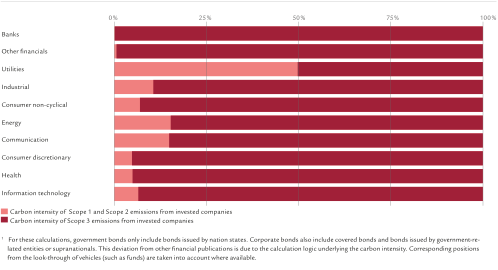
The ratio between the weighted average carbon intensity based on the issuers’ Scope 1 and Scope 2 emissions and the weighted average carbon intensity based on the issuers’ Scope 3 emissions differs according to the industry sector in question. The issuers’ Scope 3 emissions are based on estimates by the external data provider.
Relative distribution of the companies in which the Swiss Life Group’s PAM securities portfolio1 is invested by industry sector, according to the carbon intensity of Scope 1 and Scope 2 emissions compared to Scope 3 emissions, as at 31.12.2025
In accordance with the GHG Protocol Corporate Value Chain Standard, the disclosures for Scope 3 Category 15, “Investments”, comprise investments in government bonds, corporate bonds and equities. For investments in government bonds, production-based greenhouse gas emissions are taken into account. For investments in corporate bonds and equities, issuers’ Scope 1 and Scope 2 emissions are taken into account.
| Indicator | Unit | 2025 | ||
|---|---|---|---|---|
| Selected relevant Scope 3 greenhouse gas emissions (gross) | ||||
| 15 Investments | t CO₂e | 9 987 415 | ||
|
1 For these calculations, government bonds only include bonds issued by nation states. Corporate bonds also include covered bonds and bonds issued by government-related entities or supranationals. This deviation from other financial publications is due to the calculation logic underlying the carbon intensity. Corresponding positions from the look-through of vehicles (such as funds) are taken into account where available. Green, social and sustainable bonds are included in the same way as bonds without a specific focus on sustainability aspects.
|
||||
|
2 The coverage of the greenhouse gas emissions corresponds to over 90% of the amortised costs of the PAM government bond portfolio, over 80% of the amortised costs of the PAM corporate bond portfolio and over 90% of the market value of the Swiss Life Group’s PAM equity portfolio. © 2025 MSCI. Reproduced with permission. The data published by MSCI as at 31.12.2025 was used.
|
||||
Due to its structure, investments for the unit-linked insurance business are made in accordance with clients’ selections. These investments are disclosed in Swiss Life’s reporting but are not part of the quantitative sustainability targets. There are minimum requirements for third-party funds used in Swiss Life’s sustainability-related unit-linked solutions.
Further information can be found in the “Methodological Notes” section.
Carbon intensity of investments in government bonds, corporate bonds and equities from the unit-linked insurance business1,2 of the Swiss Life Group as at 31.12.2025 (attributable, as per GHG Protocol Corporate Standard, to Swiss Life’s Scope 3 emissions, category 15 “Investments”)
| Sub-portfolio | Unit | 2025 | ||
|---|---|---|---|---|
| Government bonds | t CO₂e/USD million GDP nominal | 221 | ||
| Corporate bonds | t CO₂e/USD million sales | 81 | ||
| Equities | t CO₂e/USD million sales | 90 | ||
|
1 For these calculations, government bonds only include bonds issued by nation states. Corporate bonds also include covered bonds and bonds issued by government-related entities or supranationals. This deviation from other financial publications is due to the calculation logic underlying the carbon intensity. Corresponding positions from the look-through of vehicles (such as funds) are taken into account where available. Green, social and sustainable bonds are included in the same way as bonds without a specific focus on sustainability aspects.
|
||||
|
2 The coverage of the carbon intensities corresponds to over 80% of the amortised costs of investments in government bonds, over 60% of the amortised costs of investments in corporate bonds and over 50% of the market value of investments in equities from the unit-linked insurance business of the Swiss Life Group. © 2025 MSCI. Reproduced with permission. The data published by MSCI as at 31.12.2025 was used.
|
||||
In accordance with the GHG Protocol Corporate Value Chain Standard, the disclosures for Scope 3 Category 15, “Investments”, comprise investments in government bonds, corporate bonds and equities. For investments in government bonds, production-based greenhouse gas emissions are taken into account. For investments in corporate bonds and equities, issuers’ Scope 1 and Scope 2 emissions are taken into account.
| Indicator | Unit | 2025 | ||
|---|---|---|---|---|
| Selected relevant Scope 3 greenhouse gas emissions (gross) | ||||
| 15 Investments | t CO₂e | 26 673 062 | ||
|
1 For these calculations, government bonds only include bonds issued by nation states. Corporate bonds also include covered bonds and bonds issued by government-related entities or supranationals. This deviation from other financial publications is due to the calculation logic underlying the carbon intensity. Corresponding positions from the look-through of vehicles (such as funds) are taken into account where available. Green, social and sustainable bonds are included in the same way as bonds without a specific focus on sustainability aspects.
|
||||
|
2 The coverage of the greenhouse gas emissions corresponds to over 90% of the amortised costs of investments in government bonds, approximately 80% of the amortised costs of investments in corporate bonds and over 40% of the market value of investments in equities from the unit-linked insurance business of the Swiss Life Group. © 2025 MSCI. Reproduced with permission. The data published by MSCI as at 31.12.2025 was used.
|
||||
As an asset manager for third-party clients
Further information can be found in the “Methodological Notes” section.
Carbon intensity of Swiss Life Asset Managers’ TPAM real estate portfolio1 as at 31.12.2025
| Sub-portfolio | Unit | 2025 | ||
|---|---|---|---|---|
| Real estate | kg CO₂e/m2 | 21 | ||
|
1 57% of the estimate for the carbon intensity of Swiss Life Asset Managers’ TPAM real estate portfolio for 2025 is based on consumption values from previous years. The remaining 43% was estimated using alternative methods in 2025. Information on consumption and estimates can be found in the appendix.
|
||||
Carbon intensity of Swiss Life Asset Managers’ TPAM government bond, corporate bond and equity portfolio1,2 as at 31.12.2025 (attributable, as per GHG Protocol Corporate Standard, to Swiss Life’s Scope 3 emissions, category 15 “Investments”)
| Sub-portfolio | Unit | 2025 | ||
|---|---|---|---|---|
| Government bonds | t CO₂e/USD million GDP nominal | 196 | ||
| Corporate bonds | t CO₂e/USD million sales | 90 | ||
| Equities | t CO₂e/USD million sales | 93 | ||
|
1 For these calculations, government bonds only include bonds issued by nation states. Corporate bonds also include covered bonds and bonds issued by government-related entities or supranationals. This deviation from other financial publications is due to the calculation logic underlying the carbon intensity. Corresponding positions from the fund look-through are taken into account where available. This only applies to Swiss Life funds; third-party funds are not included. Green, social and sustainable investments are in- cluded in the same way as bonds without a specific focus on sustainability aspects.
|
||||
|
2 The coverage of the carbon intensities corresponds to over 90% of the market value of the TPAM government bond portfolio, over 90% of the market value of the TPAM corporate bond portfolio and over 90% of the market value of Swiss Life Asset Managers’ TPAM equity portfolio. © 2025 MSCI. Reproduced with permission. The data published by MSCI as at 31.12.2025 was used.
|
||||
In accordance with the GHG Protocol Corporate Value Chain Standard, the disclosures for Scope 3 Category 15, “Investments”, comprise investments in government bonds, corporate bonds and equities. For investments in government bonds, production-based greenhouse gas emissions are taken into account. For investments in corporate bonds and equities, issuers’ Scope 1 and Scope 2 emissions are taken into account.
| Indicator | Unit | 2025 | ||
|---|---|---|---|---|
| Selected relevant Scope 3 greenhouse gas emissions (gross) | ||||
| 15 Investments | t CO₂e | 2 591 615 | ||
|
1 For these calculations, government bonds only include bonds issued by nation states. Corporate bonds also include covered bonds and bonds issued by government-related entities or supranationals. This deviation from other financial publications is due to the calculation logic underlying the carbon intensity. Corresponding positions from the fund look-through are taken into account where available. This only applies to Swiss Life funds; third-party funds are not included. Green, social and sustainable bonds are included in the same way as bonds without a specific focus on sustainability aspects.
|
||||
|
2 The coverage of the carbon intensities corresponds to over 90% of the market value of the TPAM government bond portfolio, approximately 90% of the market value of the TPAM corporate bond portfolio and over 90% of the market value of the TPAM equity portfolio of Swiss Life Asset Managers. © 2025 MSCI. Reproduced with permission. The data published by MSCI as at 31.12.2025 was used.
|
||||
In insurance and advisory
Swiss Life strives to take climate-related as well as other aspects into account in its insurance business and advisory services. Swiss Life’s products are closely linked to the underlying investments and capital flows. The analysis of climate-related risks and opportunities with regard to these investments thus provides valuable insights.
Swiss Life’s insurance business focuses on life insurance. Swiss Life therefore generally faces less exposure to climate-related risks in underwriting than reinsurance or property insurance companies.
Further information can be found in the “Sustainability in Insurance and Advisory” section.
General metrics
As at 31 December 2025, Swiss Life is listed in MSCI’s EU Paris-Aligned Benchmarks. This assessment is based on the MSCI methodology regarding the requirements of Delegated Regulation (EU) 2020/1818 Article 12 (1), points (d) to (g), and Article 12 (2).